
Morgan Mansell Prize for the young Victorian Melanoma Researcher of the Year – 2026
The 2026 Morgan Mansell Prize for the ‘Young Victorian Melanoma Researcher of the Year’ has just been awarded to Dr Jack Edwards. Now in its 8th year, it is adjudicated upon by Victoria’s leading oncologists and dermatologists. Dr Edward’s prize-winning research focussed on a revolutionary melanoma treatment called an Immune Checkpoint Blockade. Unfortunately at this stage, not all patients benefit from the treatment and some experience treatment-related toxicity. Being able to predict these outcomes in advance would allow rational and personalised treatment choices, maximising benefit while minimising side effects. Jack’s research found an immune feature that predicted whether a patient would benefit from treatment, and another that predicted whether they would experience severe toxicity. The next step is to test these features in larger patient cohorts, with the end goal to find robust predictive biomarkers to guide treatment choices. Congratulations also to the runners-up Dr Lewis Au and Tawany De Carvatho Gil.
The MM Prize will be awarded in perpetuity until a cure for melanoma is found. Well done to the three finalists and all the other entrants, and we hope your efforts bring that all important cure for melanoma – just that bit closer.
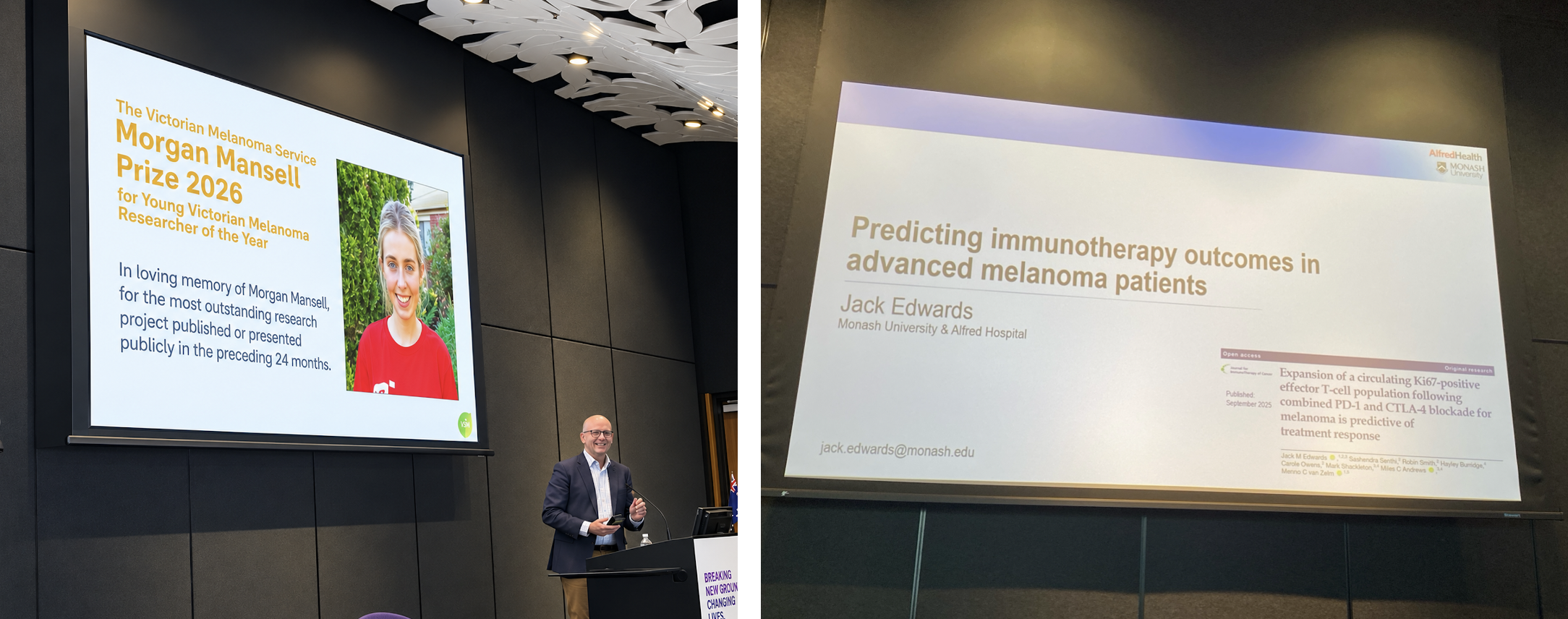
Professor Shackleton awarding the Morgan Mansell Prize for the Young Victorian Melanoma Researcher of the Year – 2026

Dr Jack Edwards with Professor Shackleton
Previous winners of the Morgan Mansell Prize
2025 Young Victorian Melanoma Researcher of the Year: Siyuan Yan. Siyuan’s research focussed on developing artificial intelligence for melanoma detection and prevention; and with the aim of making melanoma screening more consistent and accessible. The runners up: Dr Riya Patel (cancer immunology and improving patient response to melanoma therapy) and Dr Lewis Au (predictive biomarkers of immunotherapy treatment response.
2024 Young Victorian Melanoma Researcher of the Year: Dr Julia Lai-Kwon. Dr Lai-Kwon’s prize winning research was aimed at improving the quality of life of people living with Stage III/IV Melanoma. The runners-up: Dr Cristina Vico-Alonso (early detection of melanomas using circulating tumour-specific antibodies; and A. Oloruntoba (appropriateness of using AI apps on smartphone to diagnose Melanoma).
2023 Young Victorian Melanoma Researcher of the Year: Dr Jennifer Soon. Dr Soon’s prize winning research was aimed at better support assessments of new cancer treatments in order to improve access to novel therapies. It involved horizon scanning to identify promising medicines with the hope that early detection of potential medicines can result in better outcomes and streamline what is often a cumbersome process. The runners up: Dr Deval Mehta (AI models in dermatology) and Dr Emma Bawden (CD4+T cell immunity in melanoma).
2022 Young Victorian Melanoma Researcher of the Year: Dr Prachi Bhave. Dr Bhave’s research was on efficacy of checkpoint inhibitors in acral melanoma (melanomas that occur on soles of feet, palms, nails and the most common melanoma in people with darker skin).

2021 Victorian Melanoma Researcher of the Year: Dr Sophie Lim. Dr Lim’s research was on lentigo maligna (precursor to melanoma usually found on the head/face of older people.

2020 Young Victorian Melanoma Researcher of the Year: Dr Emily Lelliot. Dr Lelliot’s award winning research was on examining the effects of targeted therapies on anti-tumor immunity in melanoma.
2019 Young Victorian Melanoma Researcher of the Year: Simone Park.

Discover more from Don't MS with Morgs
Subscribe to get the latest posts sent to your email.


One thought on “MORGAN MANSELL PRIZE: VICTORIAN MELANOMA RESEARCHER OF THE YEAR”